
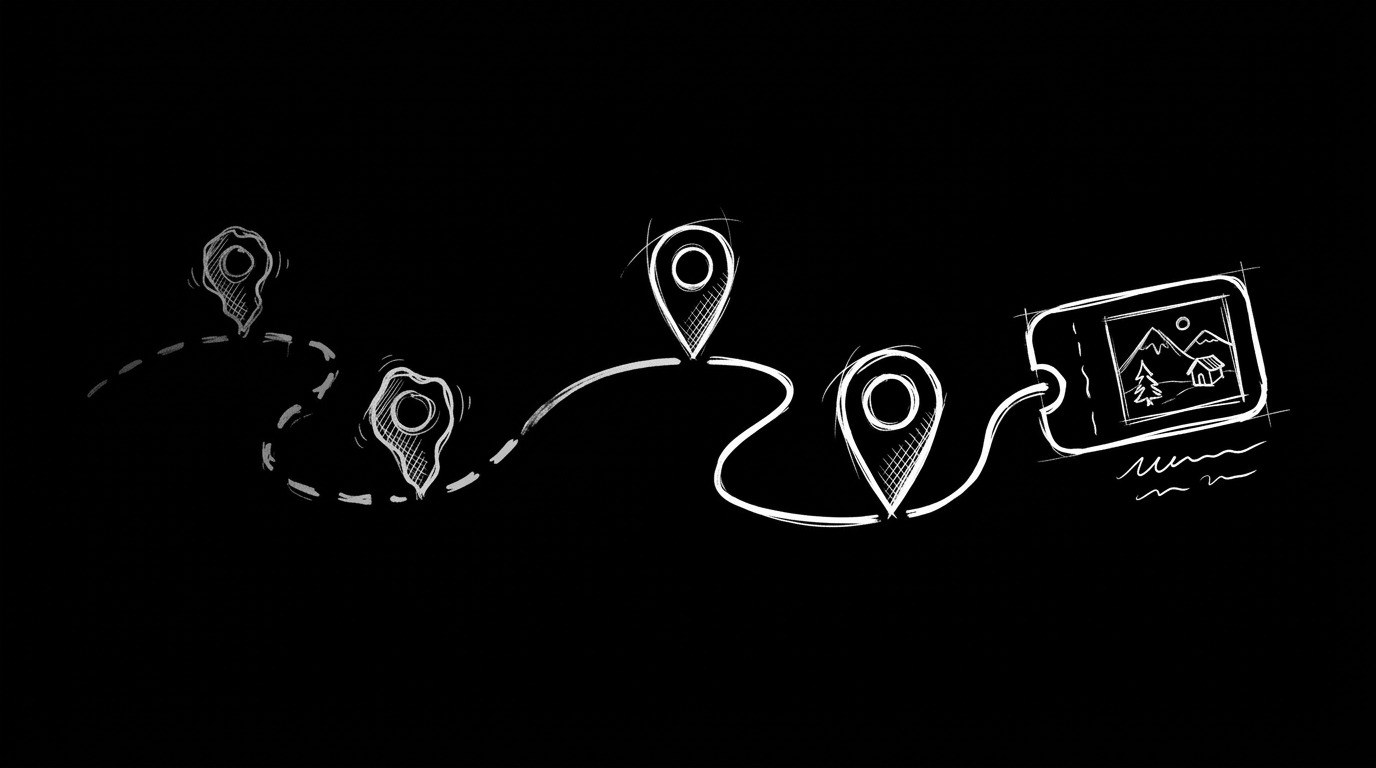
For a decade, Google Timeline quietly answered a question nothing else could: where was I on that Tuesday? Then Google moved it onto the phone, shut the web version down, and in the shuffle a lot of people opened the app to find years of their history simply gone. The lesson wasn't “Google is careless.” It was: if your life's map lives on someone else's server, it's theirs to lose.
Retrography keeps a location history the way it should have worked all along. Your iPhone already notices when you arrive somewhere and when you leave — iOS visit detection, running in the background, no start button, no check-in. Retrography turns that into a log: the place, the arrival time, the leaving time, on a mini-map, on the day it happened.
Visits get matched to real places — home, work, the café, the dentist — not raw coordinates. Tap any place and the Location Explorer shows how often you go, how long you tend to stay, and every visit on one map. Drives between places are traced along real roads, so a moving day reads like a journey, not a teleport.
And unlike a bare map, your places sit next to everything else: the photos you took there, the music in your ears on the walk, the weather that morning. Timeline never had that. A location history is only half a memory — Retrography keeps the whole day.
Where does all this live? On your phone and in your own iCloud. Nowhere else. Location is processed on-device; there is no Retrography server holding your map, which means there is no server to lose it, leak it, or shut it down. You can export everything, any time, and walk away with it.